Defence · operational environments
Passive sensing for operational environments.
We’re developing the same sensing approach for defence applications: nodes that transmit no radar signal, carried by the units they support, with field evaluation planned to assess performance against operational requirements.

What if seeing the threat reveals your position?
- The node emits no radar signal
- No transmission
- Intended emplacement by two people
- Small crew
- Nodes designed to work together
- Networked
- Targeted field evaluation milestone
- Q4 2026
These are design intentions and planning targets, not validated results. Detection ranges and performance figures are only stated once measured, and then in the context of the conditions they were measured in.
Intended advantage
Deployed, not installed.
An emitting radar transmits every time it looks. A passive node reads the illumination already crossing the area and listens for reflections — which is why we are developing it for positions where transmission is unwelcome.
Request a briefing →The node in the field
Carried in, set up on a tripod.
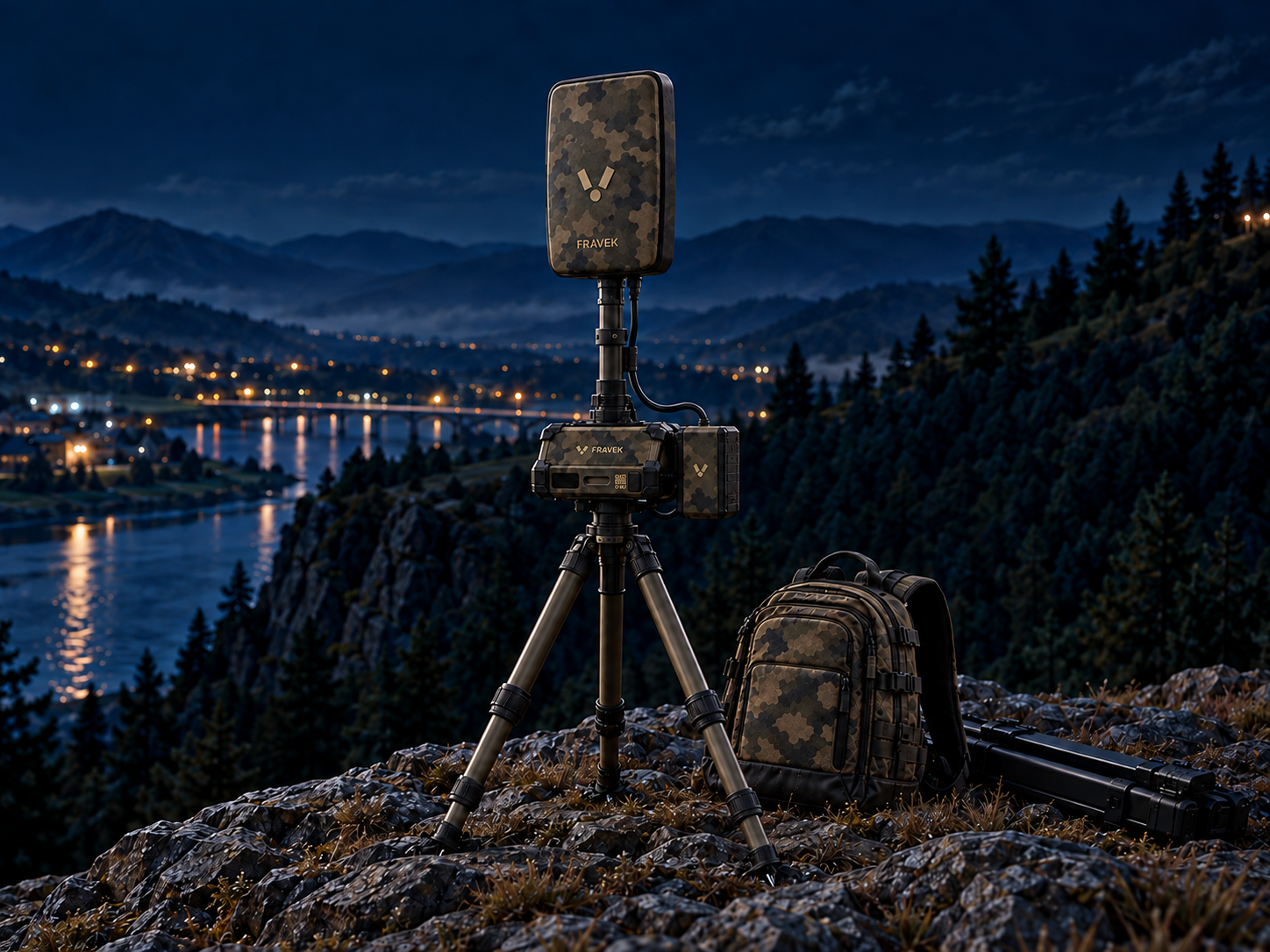
The defence configuration is intended to be transported by a small crew and emplaced on a portable tripod, with a camouflaged enclosure suited to field positions.
Defence configuration under development. Final form is shaped by field evaluation.
Design principles
No radar transmission
The node receives existing signals rather than transmitting a radar signal of its own, which is the basis of its intended signature advantage.
Illumination we do not own
The signals used belong to the surrounding civil radio environment rather than to the sensor, which shapes how the system is intended to behave in contested spectrum.
Designed to move
Intended to be carried, emplaced and brought online by a small crew, without vehicles, generators or fixed works.
Feeds the existing picture
Software is being developed to deliver tracks into the command picture a unit already works from, rather than adding an isolated screen.
Evaluation programme
From development to field evidence.
Our next milestone is measured performance in Ukraine and at Swedish pilot sites, targeted for Q4 2026. Development is tied to what is actually recorded in those conditions.
Step 1
Scoped evaluation
A package sized to one site and its sector, agreed on the capability to be assessed rather than a component list.
Step 2
Field measurement
Nodes in operational positions, with structured reporting against the drone types that matter to the user.
Step 3
Continuous tuning
Recorded data feeds back into the processing chain, with engineers inside the same loop as the deployed nodes.
Briefings for defence and government organisations.
Capability, current development stage and limitations are discussed openly. Technical architecture and evaluation details are available to relevant organisations on request.
Request a briefing